


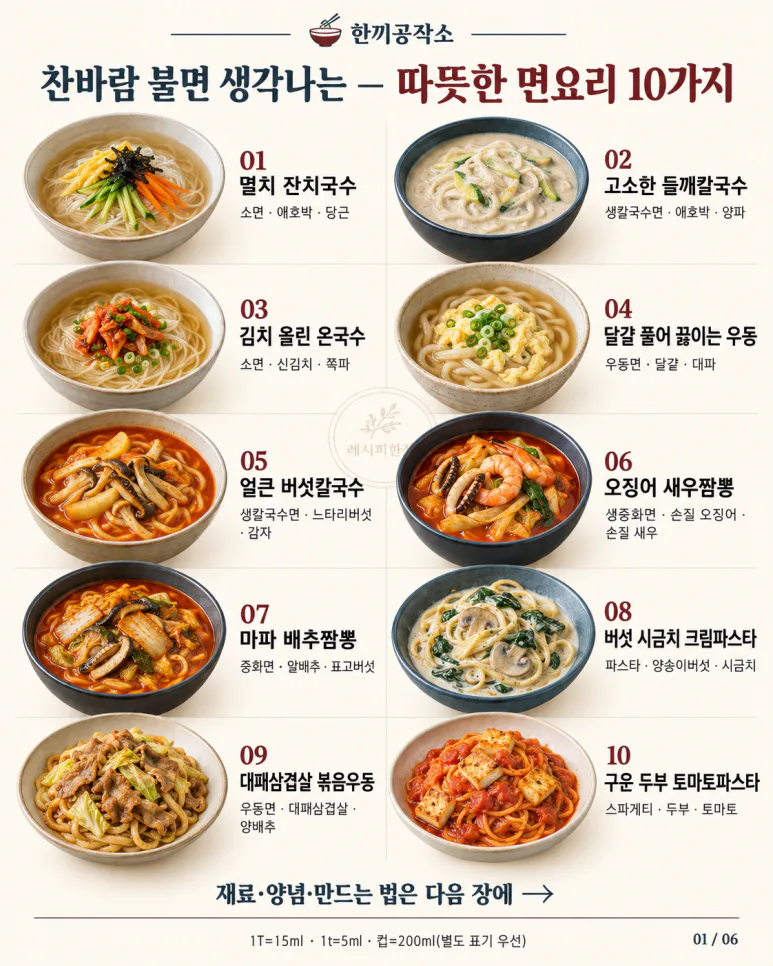
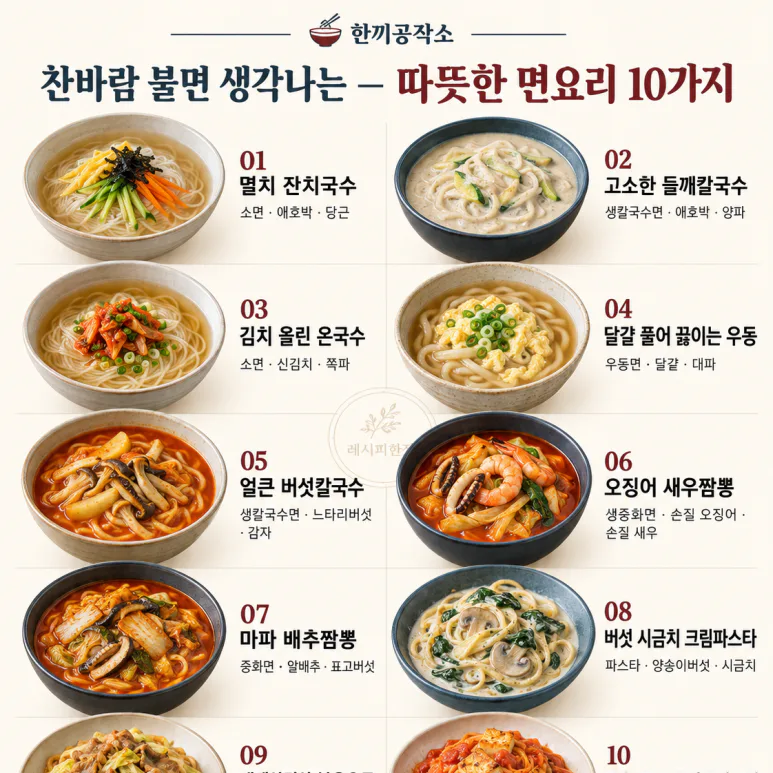
Always comes to mind when the cold wind blows — 10 hot noodle dishes
On evenings when you have to close the windows, I think of a warm bowl of noodles. Try alternating between clear broth, sesame seeds, and stir-fried noodles. 1. Mackerel banquet noodles for 2 servings Ingredients: rice noodles 200g · zucchini 80g · carrots 40g · shiitake mushrooms 30g · 1 egg · 15g scallions · 1/2 sheet of seaweed Seasoning: prepared mackerel broth 1L · Korean soup soy sauce from 2t · cooking oil 2t · salt from 2 pinches · water for boiling noodles 2L How to make: zucchini
If it's an evening when you have to close the window, have a warm side of food.
Do you remember the bowl? Clear broth, sesame seeds, stir-fried noodles.
Please choose one at a time.
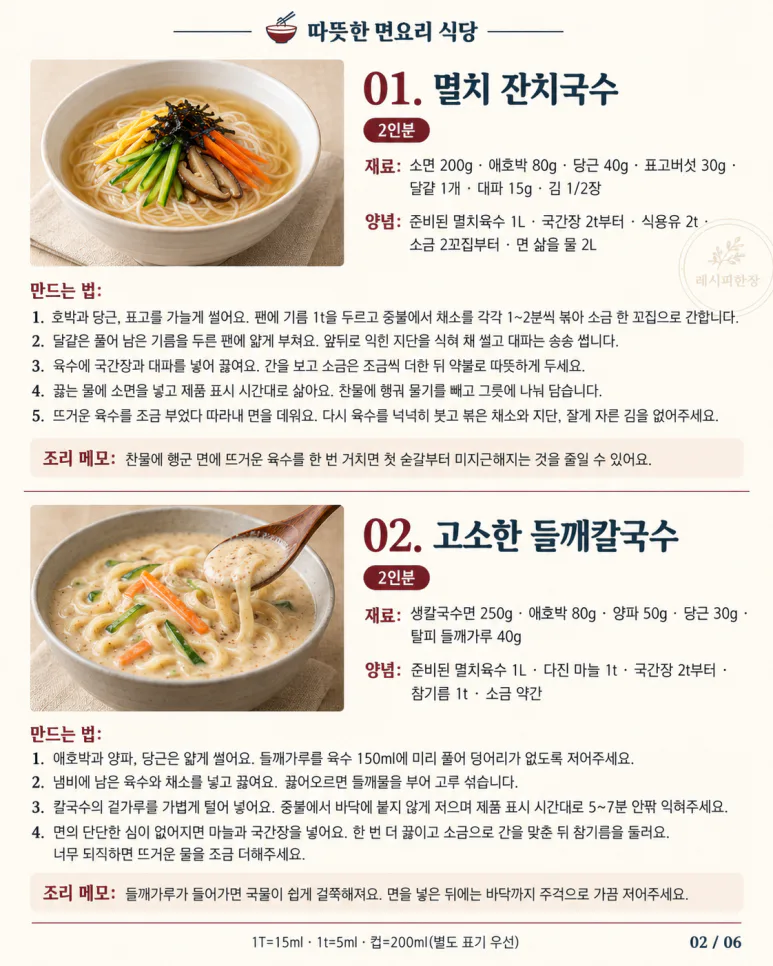
1. Anchovy banquet noodles
2 servings
material
Rice noodles 200g · Zucchini 80g · Carrot 40g ·
Shiitake mushrooms 30g · 1 egg · 15g scallions ·
Kim 1/2 page
spice
Prepared anchovy stock 1L · From 2t Korean soup soy sauce ·
2t of cooking oil · from 2 pinch of salt ·
2L water for boiling noodles
How to make it
Slice the pumpkin, carrots, and shiitake thinly. In the pan.
Heat 1t of oil and cook the vegetables on medium heat.
Fry each for 1~2 minutes, then add a pinch of salt.
I will try.
Beat the egg and pour it thinly into a pan with the remaining oil.
Cook it. Chill the sliced slices cooked front and back and cut them.
The scallions are chopped finely.
Boil the broth with Korean soup soy sauce and scallions. Season
After watching, add a little more salt and heat it gently at low heat.
Please leave it.
Put the soymilk noodles in boiling water and cook according to the product's expiration date.
Boil it. Rinse it in cold water, drain the water, and divide it into bowls.
I will attach it.
Pour a little hot broth and pour the noodles out.
Heat it up. Pour the broth generously again and stir-fry the vegetables and
Jidan, please put on the finely chopped kimchi.
After rinsing the noodles in cold water, place them in a bowl of hot broth for one time.
You can reduce it to be lukewarm from the first spoon
There is.
2. Toasty sesame noodle soup
2 servings
material
Fresh knife noodles 250g · Zucchini 80g ·
Onions 50g · Carrots 30g ·
Hair removal sesame seed powder 40g
spice
Prepared anchovy stock 1L · minced garlic 1t ·
Korean soup soy sauce from 2t · sesame oil 1t · a little salt
How to make it
Slice the zucchini, onion, and carrot thinly.
Dissolve sesame powder in 150ml of broth in advance.
Please swirl it so there are no lumps.
Add the remaining broth and vegetables to the pot and boil.
When it boils, pour in the sesame water and mix well.
Lightly whisk in the outer powder of the kalguksu noodles.
Shake the product to prevent it from sticking to the floor from the middle of the flame and display the product label.
Please learn it within about 5~7 minutes depending on the time.
If the noodles lose their firm texture, garlic and Korean soup soy sauce
Put it in. Boil again and season with salt.
Wrap around the back sesame oil. If it's too stiff, it will be hot.
Please give me a little more water.
If sesame powder is added, the broth thickens easily.
After putting the noodles in, occasionally use a spatula to reach the bottom.
Please give it away.
I start with the seasoning when making nutty sesame noodle soup.
Please measure it. It's a hassle finding the spoon while the fire is on.
I liked it that it got shorter.
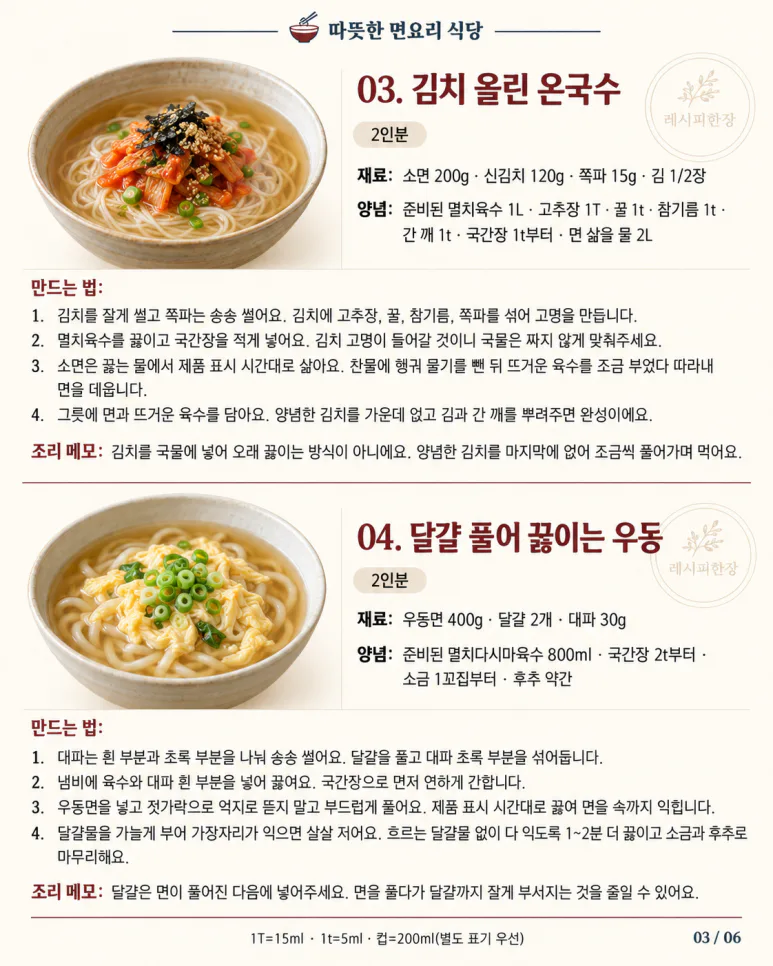
3. Ongguksu with kimchi on top
2 servings
material
Glass noodles 200g · Fresh kimchi 120g · Green onions 15g ·
Kim 1/2 page
spice
Prepared anchovy stock 1L · gochujang (Korean red chili paste) 1T · Honey 1t ·
sesame oil 1t · Clean liver 1t · Korean soup soy sauce from 1t ·
2L water for boiling noodles
How to make it
Cut the kimchi finely and chop the scallions finely. In the kimchi.
gochujang (Korean red chili paste), honey, sesame oil, mix with bokkapi for garnish
Makes it.
Boil the anchovy stock and add a little Korean soup soy sauce. kimchi
Since the garnish will go in, the broth should not be too salty.
Please match it.
Rice noodles are cooked in boiling water according to the product expiration date.
Boil it. Rinse it in cold water to drain the water, then boil it in hot water.
Pour a little broth and take it out to warm up the noodles.
Put the noodles and hot broth in a bowl. Seasoned
If you put kimchi in the middle and sprinkle seaweed and sesame seeds on it
It's complete.
The method of putting kimchi broth into it and boiling it for a long time
No. Put the seasoned kimchi on top at the end and add it little by little.
Eat it as you eat it.
4. Eaten udon with eggs beaten and boiled
2 servings
material
Udong noodles 400g · 2 eggs · 30g scallions
spice
Prepared anchovy dashi broth 800ml ·
Korean soup soy sauce From 2t · From 1 pinch of salt · A little pepper
How to make it
Cut the scallions into thin slices, separating the white part and the green part.
Slice it. Crack the egg and cut the green part of the scallions.
Mix it up.
Put the broth and the white part of the green onions into the pot and boil.
We will go to Korean soup soy sauce first.
Don't force the udon noodles to be torn with chopsticks after adding them.
Dissolve gently. Boil according to the product's instructions.
Cook the noodles all the way to the inside.
Pour the egg white thinly and when the edges are cooked, gently.
I stir it. Without running egg water, everything is
Cook for 1~2 minutes longer until cooked through, then season with salt and pepper.
Let's finish it.
Please add the eggs after the noodles are softened. Noodles
You can reduce the amount of it that breaks down into small pieces, even the eggs.
There is.
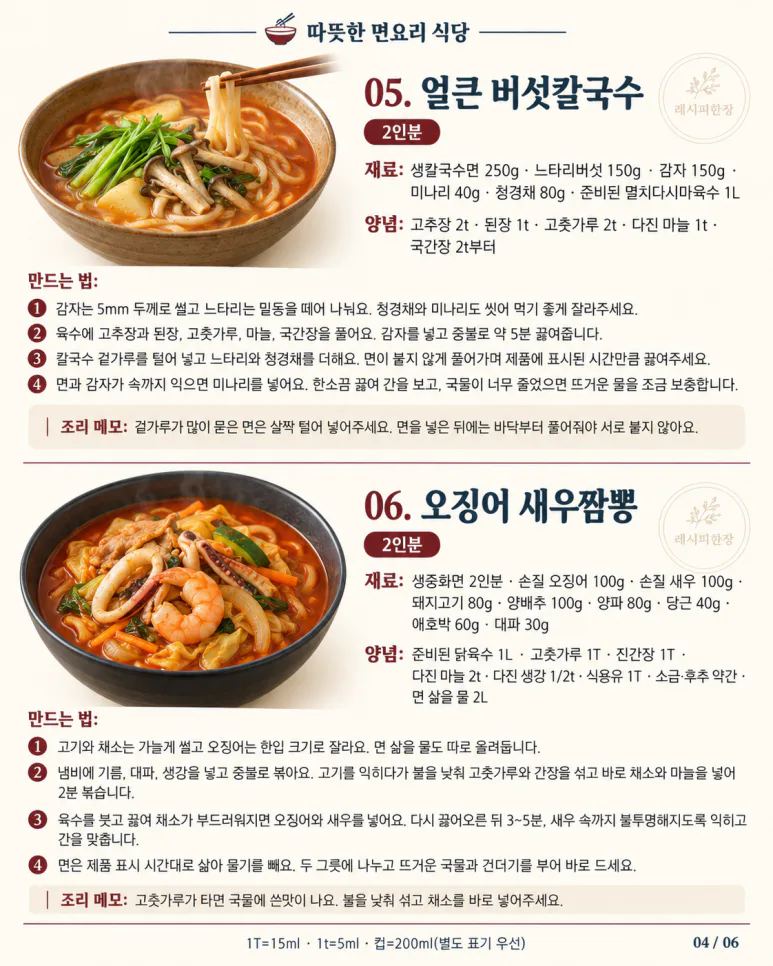
5. Spicy mushroom kalguksu
2 servings
material
Fresh knife noodles 250g · Wood ear mushrooms 150g ·
Potatoes 150g · Minari 40g · Chungkyeongchae 80g ·
Prepared anchovy and dashi broth 1L
spice
gochujang (Korean red chili paste) 2t · doenjang 1t · gochugaru (Korean red pepper flakes) 2t ·
minced garlic 1t · Korean soup soy sauce from 2t
How to make it
Slice the potatoes 5mm thick and cut the base of the radish.
Cut it up and share. Wash and eat the chugyeongchae and the mint too.
Please cut it well.
Broth with gochujang (Korean red chili paste) doenjang, gochugaru (Korean red pepper flakes), garlic,
Open Korean soup soy sauce. Add the potatoes and cook at medium heat for about 5 minutes.
Boil it.
Add the shredded flour of the kalguksu and the radish and cucumber.
Add it. Dissolve it gradually so that it does not stick to the gauze and apply to the product.
Please boil for the indicated time.
When the noodles and potatoes are cooked through, add the spinach.
Cook it for a while, taste it, and if the broth is too thin,
Add a little hot water.
Brush off the loose particles on the surface of the noodles lightly.
Please put it in. After putting the noodles in, start from the bottom.
If you don't let them go, they won't stick together.
6. Squid and shrimp jjambong
2 servings
material
Fresh Chinese screen for 2 people · 100g of prepared squid ·
Prepared shrimp 100g · pork 80g ·
Cabbage 100g · Onion 80g · Carrot 40g ·
Zucchini 60g · Green onions 30g
spice
Prepared chicken broth 1L · gochugaru (Korean red pepper flakes) 1T ·
dark soy sauce 1T · minced garlic 2t ·
Chopped ginger 1/2t · Cooking oil 1T ·
A little salt and pepper · 2L of boiling water for boiling the noodles
How to make it
Slice the meat and vegetables thinly, and slice the squid into one bite.
Cut it into pieces. Boil the noodles separately in water.
I will upload it.
Put oil, scallions, and ginger in the pot and cook on medium heat.
Sauté. While cooking the meat, turn the heat down gochugaru (Korean red pepper flakes) and
Mix the soy sauce and immediately add the vegetables and garlic and cook for 2 minutes.
Stir-fry.
Pour the broth and boil until the vegetables become soft, then add the squid and
Add the shrimp. Bring it back to a boil and cook for 3~5 minutes,
Cook until the shrimp is completely translucent and season it.
Correct.
The noodles are boiled and drained according to the product's expiration date.
Divide into two bowls and pour the hot broth and the solids.
Please give it right away.
If gochugaru (Korean red pepper flakes) burns, it tastes bitter in the broth. Turn off the fire.
Lower the heat and mix, then add the vegetables immediately.
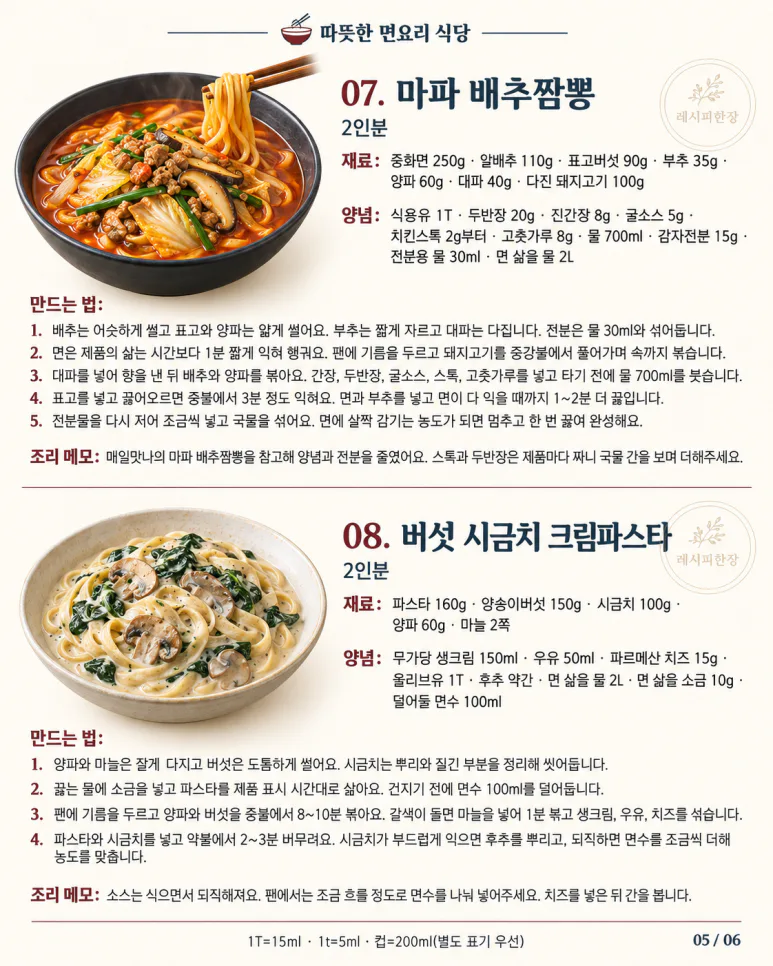
7. Mapo cabbage jjambong
2 servings
material
Chinese cabbage 250g · Cabbage 110g ·
Shiitake mushrooms 90g · Green onions 35g · Onions 60g ·
40g scallions · 100g minced pork
spice
Cooking oil 1T · doubanjiang 20g · dark soy sauce 8g ·
Prawn sauce 5g · Chicken stock from 2g ·
gochugaru (Korean red pepper flakes) 8g · Water 700ml ·
Potato starch 15g · Starch-used water 30ml ·
2L water for boiling noodles
How to make it
Cut the cabbage into small pieces and the shiitake mushrooms and onions thinly.
Cut it. Cut the scallions short and chop the green onions finely.
Mix the starch with 30ml of water and set aside.
The noodles are cooked 1 minute shorter than the product's boiling time.
Rinse. Put oil in the pan and cook the pork.
Cook it over medium heat until it softens and cooks through.
Add the scallions to infuse the flavor, then add the cabbage and onions.
Sauté. Soy sauce, doubanjiang, oyster sauce, stock,
Before putting gochugaru (Korean red pepper flakes) in and driving, add 700ml of water.
I will paint.
When you put shiitake mushrooms and bring it to a boil, simmer on medium heat for about 3 minutes.
Cook it. Add the noodles and scallions and let the noodles cook until they are all done.
Boil for another 1~2 minutes until done.
Stir the starch powder again and add it little by little and the broth
Mix it. Stop when the concentration slightly coats the noodles.
Boil it once and finish it.
Based on Mae-dil-na's Mapo cabbage jjampong, use the seasoning and
I reduced the powder. Stock and doubanjiang are different for each product.
Please add more while checking the seasoning of the broth.
8. Mushroom spinach cream pasta
2 servings
material
Pasta 160g · Shiitake mushrooms 150g ·
Spinach 100g · Onion 60g · Garlic 2 cloves
spice
Unsweetened fresh cream 150ml · Milk 50ml ·
Parmesan cheese 15g · Olive oil 1T ·
A little pepper · 2L water for boiling the noodles ·
Boiling the noodles with 10g of salt · 100ml of the noodle water to save
How to make it
Chopped onions and garlic finely, and mushrooms thickly.
Cut it. Remove the roots and the tough parts of the spinach.
I'll wash it up.
Add salt to boiling water and cook pasta according to the product label.
Live according to time. Before you catch it.
Pour down 100ml of rice water.
Put oil in the pan and add onions and mushrooms
Sauté for 8~10 minutes on medium heat. When it turns brown.
Add garlic and stir-fry for 1 minute, then add heavy cream, milk, and cheese.
Mix.
Add the pasta and spinach and cook on low heat for 2~3 minutes.
Toss it. When the spinach is cooked softly, add pepper.
Sprinkle and, if necessary, add a little more rice water to increase the concentration.
Correct.
The sauce gets thick and solid as it cools down. In the fans, it's a little bit...
Please divide the water into enough to flow. Add the cheese.
After putting it in, check the seasoning.
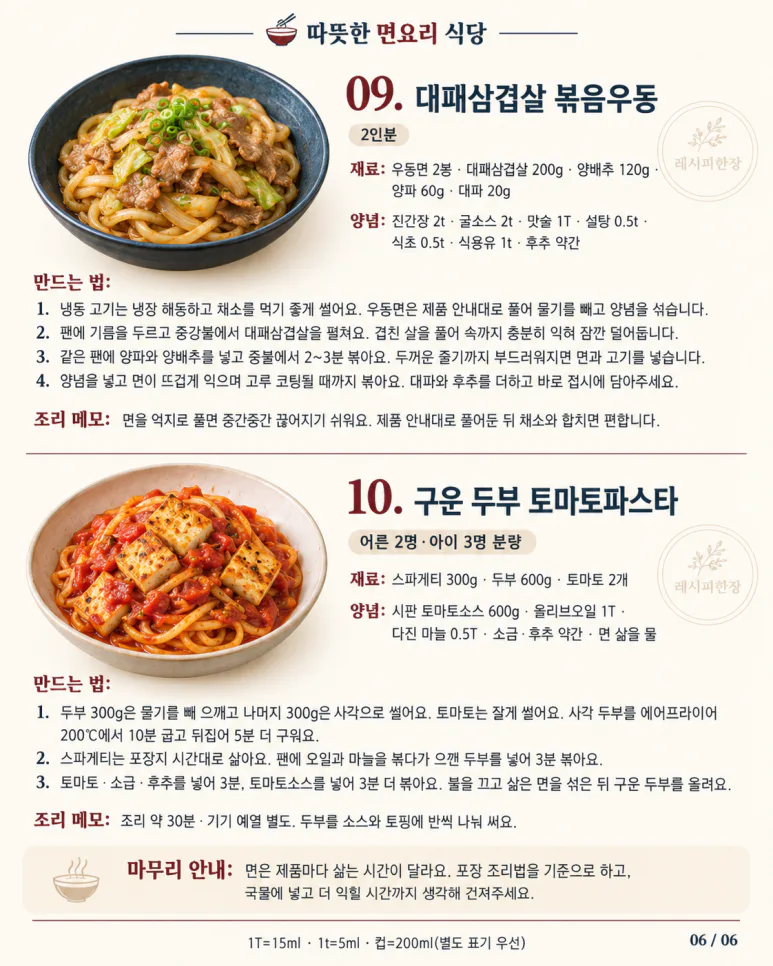
9. thinly sliced pork belly stir-fried udon
2 servings
material
2 packs of udon noodles · thinly sliced pork belly 200g ·
Cabbage 120g · Onion 60g · Green onion 20g
spice
dark soy sauce 2t · Oyster sauce 2t · Makgeolli 1T ·
Sugar 0.5t · Vinegar 0.5t · Cooking oil 1t ·
A little pepper
How to make it
Thaw frozen meat in the refrigerator and eat the vegetables nicely.
Slice it. Soak the udon noodles according to the product instructions to remove the moisture.
Mix the seasoning without it.
Put oil on the fan and in the middle heat flame, thinly sliced pork belly
Spread it out. Unfold the overlapping flesh and cook it thoroughly until it reaches the inside.
I'll pause for a moment.
Put onions and cabbage into the same fan
Sauté over medium heat for 2~3 minutes until the thick stems are cooked through.
When it becomes soft, add the noodles and meat.
The noodles will cook hot and be evenly coated with the seasoning when added.
Stir until done. Add green onions and pepper and stir right away.
Please put it in a plate.
If you force the fabric to loosen, it is easy to break it off in between.
After dissolving as instructed on the product, combine with vegetables.
It's convenient.
In my case, thinly sliced pork belly stir-fried udon is on a small plate.
First, put it in. Instead of putting a lot at once.
It was easier to take less as I watched how much I was eating.
10. Grilled tofu tomato pasta
2 adults and 3 children's portion
material
Spaghetti 300g · Tofu 600g ·
2 tomatoes
spice
Pre-packaged tomato sauce 600g · Olive oil 1T ·
minced garlic 0.5T · a little salt·pepper ·
Boil the noodles in water
How to make it
Drain and mash 300g of tofu.
Cut the remaining 300g into squares. The tomatoes are
I cut it into small pieces. Square tofu.
Bake for 10 minutes in the 200℃ air fryer
Flip it and bake for another 5 minutes.
Spaghetti is boiled according to the packaging time in the pan.
Sauté oil and garlic, then add mashed tofu and cook for 3 minutes.
Sauté it.
Add tomato, salt, pepper and cook for 3 minutes, tomato sauce
Add and stir for 3 more minutes. Turn off the heat and add the cooked noodles.
Place the mixed and baked tofu on top.
The cooking time for noodles varies depending on the product.
Based on the packaging cooking method,
Put it in the broth and cook until more cooked
Please think about it and save it.
#OneMealWorkshop #OctoberHomeMeal #AutumnHomeMeal
#Home-cookedmealrecipe #Menurecommendation #Mackerel Party Noodle Soup
#Spicy Sesame Knife Noodle #Kimchi-Topped Noodle
#Udong with egg boiling #Spicy mushroom kalguksu
#Shrimp and Squid Jjamppong #Mapo Napa Cabbage Jjamppong
#mushroom spinach cream pasta
#thinly sliced pork belly stir-fried udon #grilled tofu tomato pasta