


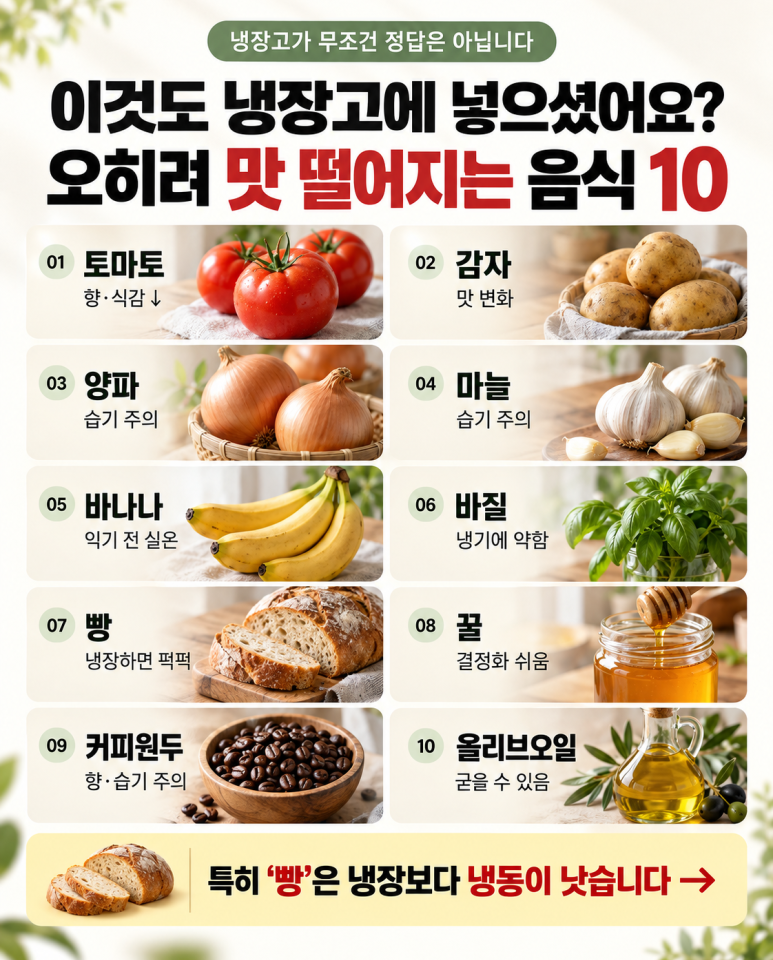
Did you also put this in the refrigerator? 10 ways to store food that preserve taste and texture
When you come back after checking the fridge, you'll start by opening it. I think it'll keep things fresher longer if you keep them cold. However, each food has its own preferred storage environment, which varies slightly. In cold places, the aroma can fade or the texture might change. That doesn't mean all the foods below are strictly forbidden in the fridge. You should also consider the ripeness, the level of preparation, and the temperature in your home. Here are 10 foods to know before putting them in the fridge, along with exceptions.
When you come back after watching the movie
First, we will open the refrigerator.
If you keep it cold, everything lasts longer.
It seems fresh.
But each food has its own favorite
The storage environment changes slightly.
The fragrance fades in a cold place or
In fact, the texture changes as well.
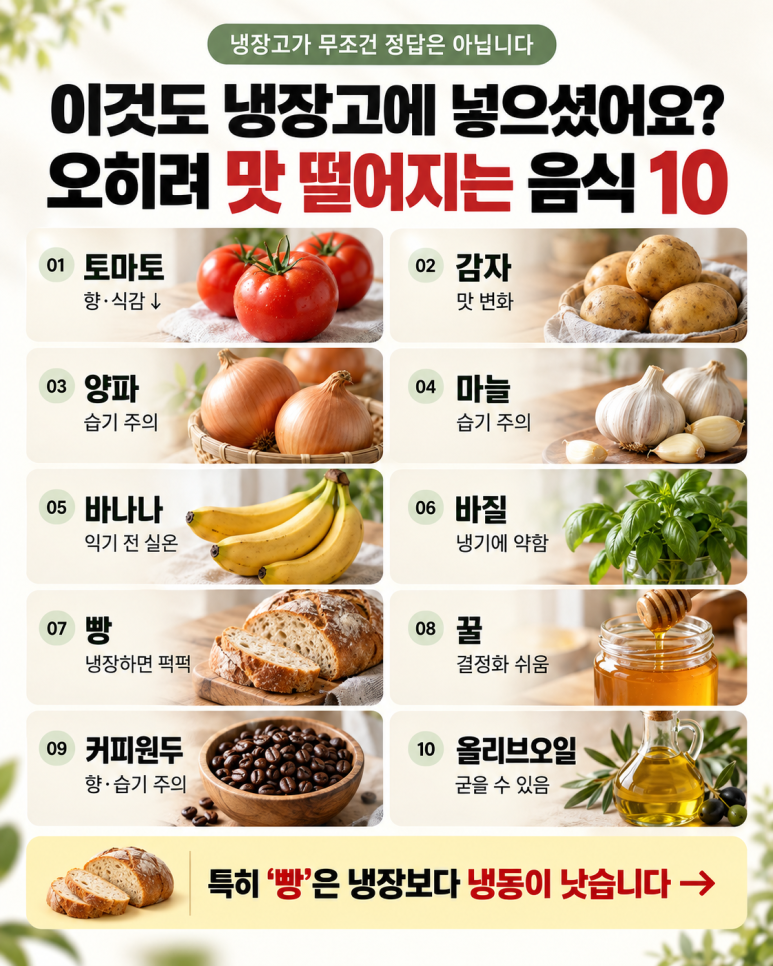
That doesn't mean the food below is all
It doesn't mean no refrigeration.
The degree of ripeness and the extent of grooming,
We have to check the temperature inside the house together.
It's good to know before putting it in the refrigerator.
I have summarized 10 kinds of food and exceptions.
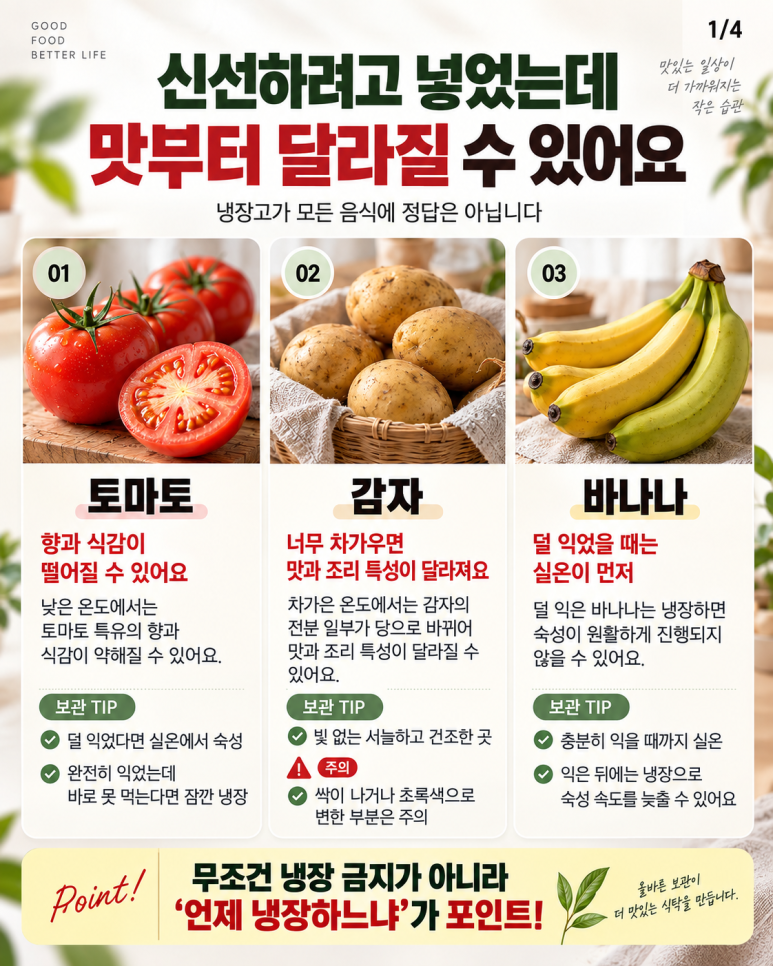
1. Tomato — if it's not ripe yet, start from room temperature
Unripe tomatoes are
At room temperature away from direct sunlight
It's good to eat it after cooking.
If you keep it too cold for too long
The unique aroma and texture may become weaker.
If it's completely cooked but you can't eat it right away
Slow down the speed of softening by refrigerating it.
If you just take out enough to eat in advance
I like to smell it more when it's cold.
Tomatoes that are cut up have a different story.
Put in an airtight container and refrigerate.
Please eat as soon as possible.
2. Potatoes — in a cool and dark place
Sensors are not touched by light
Keep it in a cool and ventilated place.
Store in an unwashed state and
Please check to make sure there is no moisture.
At low temperatures, depending on the variety and storage conditions
The sugar content and cooking properties may differ.
However, you shouldn't refrigerate potatoes.
You don't have to be certain about it.
If the house is hot or it is difficult to store
Please also check the product storage guide.
The green color spreads widely or
Avoid potatoes with a lot of sprouts,
If the condition is suspicious, I don't eat it.
3. Whole onion — keep it ventilated with the skin intact
Dry-skinned whole onions
I like cool and dry places.
Put it in a basket or a bucket.
Please allow the air to circulate.
If you tightly tie it in a plastic bag
It is easy to get damp inside.
Wet onions and soft onions are
It's good not to build it up together.
The onions peeled or cut are
Please put it in an airtight container and refrigerate it.
With the onions that have been cleaned of the storage method of canned onions
It shouldn't be applied as is.
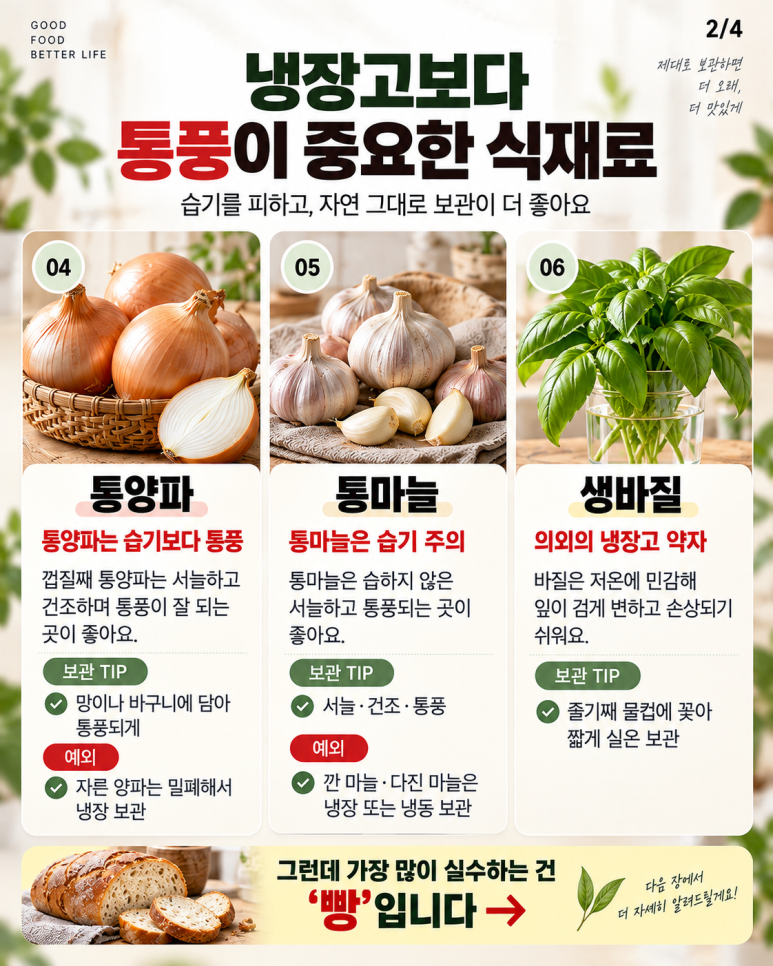
4. Whole garlic — cool and dry without moisture
Whole garlic with dried skin
Cool and dry
Store it in a place with good ventilation.
It's important to keep it dry so it doesn't get wet.
Cracked garlic or minced garlic is
Please store in the refrigerator or freezer.
Keep it refrigerated for use right away.
If you want to keep it for a long time, freeze it in small portions.
If I finely grind minced garlic
Only enough as needed when boiling the soup
It's easy to take out and use.
5. Banana — divide it into before and after it is ripe.
Unripe bananas
Please cook it thoroughly at room temperature.
If you refrigerate it early, it will mature.
It may not be smooth.
After it is ripe properly, refrigerate it.
You can slow down the maturation speed.
Even if the skin turns brown at this time
It doesn't mean that it hurt all the way inside.
Don't just look at the color of the skin before eating.
Please also check the condition and smell of the flesh.
If there is mold or a strange smell
It's good not to eat.
6. Fresh vegetables — avoid the cold wind
Raw vegetables are sensitive to low temperatures
The leaves turn dark in the refrigerator or
It can be easily damaged.
If the line is attached
Submerge the end of the stem in a clean water cup.
Leave it in the indoor space without direct sunlight for a while.
Please use it as soon as possible.
Make sure the leaves are not soaked in water
Please also clean the water properly.
In the hot indoor space of summer
It doesn't mean to keep it for a long time.
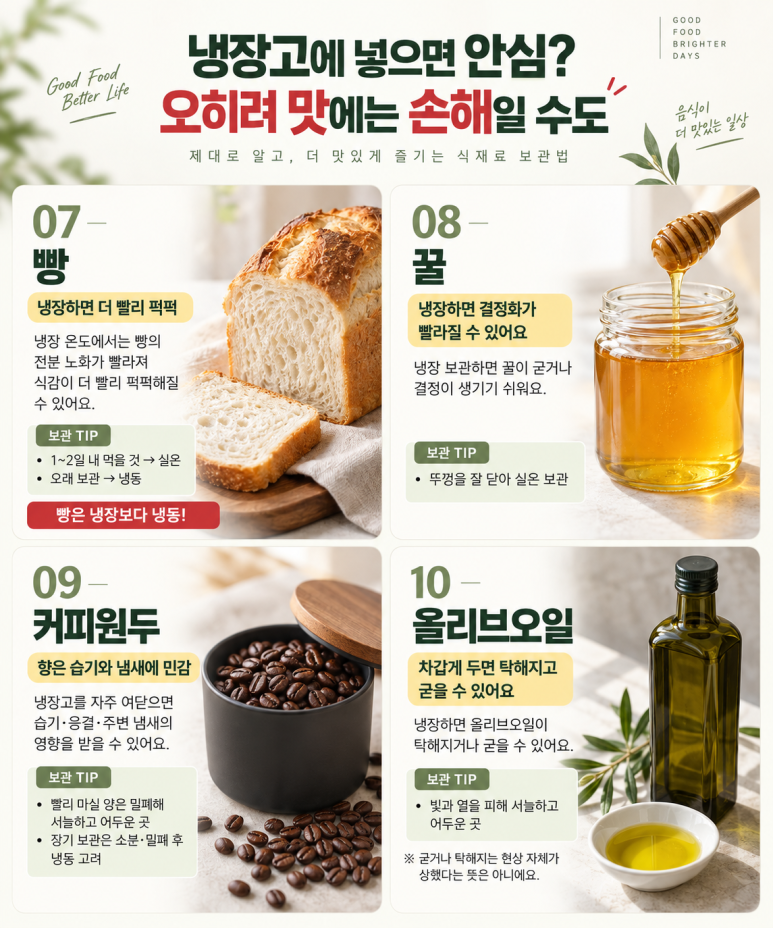
7. Bread — things that will stay for a long time should be frozen.
Ordinary bread like white bread is
Starch aging accelerates at cold temperatures.
It can feel mushy.
It's a different texture change from mold.
The bread that will be eaten soon in a cold environment is
Pack it and store it at room temperature for a short time,
Share the bread you leave behind enough to eat once.
It's better to freeze it.
I divided the bread into two pieces and froze them early.
You don't need to take out one bag every morning.
It was much easier to prepare.
Bread with cream or custard inside
According to this standard, it should not be left at room temperature.
According to the ingredients and product labels
Please keep it in the refrigerator.
8. Honey — close the lid and keep it at room temperature.
Ordinary pure honey is
Just seal it and store it at room temperature.
If you leave it cold, it will just turn cold again.
It may be uncomfortable to cut when a decision is made.
The speed of decision-making
It depends on the type of honey and temperature.
Just the fact that a decision was made
It's not spoiled or fake honey.
To prevent moisture from getting in
Use a clean and dry spoon.
Processed products mixed with other ingredients are
Please follow the product storage instructions.
9. Coffee beans - sealing and moisture blocking
Roasted beans are affected by air and moisture,
It is affected by light and heat.
The amount to eat frequently is opaque
Put it in an airtight container and keep it cool.
If you put it in the refrigerator and take it out
Moisture is created due to temperature difference or
The influence of the smell of food around you
You can receive it.
Beans that can be stored for a long time are
After grinding it into small pieces and tightly sealing it
You can also consider the method of freezing.
Reduce the number of times you open and close it repeatedly.
10. Olive oil - Keep away from light and heat
Olive oil, close the lid tightly.
Store it in a cool and dark place.
Right next to the stove
Please avoid the window facing the sunlight.
If you refrigerate it, it gets cloudy.
Some parts can harden.
The change that comes from getting cold itself
It doesn't mean it's hurt.
To store it conveniently for use
Avoiding light and heat is the priority.
Just whether it hardens cold
You can't tell if it's good oil.
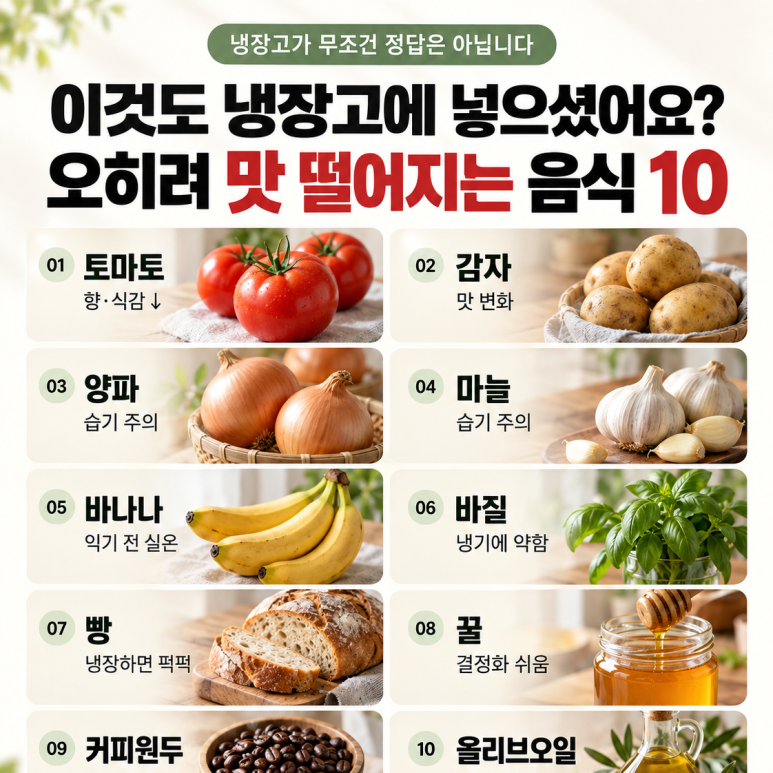
Before putting it in the refrigerator, just check this.
Is it whole or has it been processed.
Whether it's not cooked enough, or cooked enough.
Whether to eat today or to wait and eat later.
Even if you divide these three things
It becomes easier to decide on the storage place.
Chopped onions and peeled garlic are refrigerated,
If you need ripe tomatoes and bananas, refrigerate them.
If you want to keep regular bread for a long time, it's frozen.
Store at room temperature in a hot kitchen
It doesn't mean to ask blindly.
Check the storage environment and the state of the food
First follow the storage method written on the packaging.
Instead of always filling the refrigerator
Please find a seat that is appropriate for the food.
After the next shopping
Try to share and store the bread once.
#Food Storage Act
#Food material storage
#Refrigerator cleaning
#Refrigerated storage
#Store at room temperature
#Frozen storage
#TomatoStorage
#Potato storage
#Onion storage
#Garlic storage
#Banana storage
#Basil storage
#Bread storage
#Coffee bean storage
#Olive oil storage