


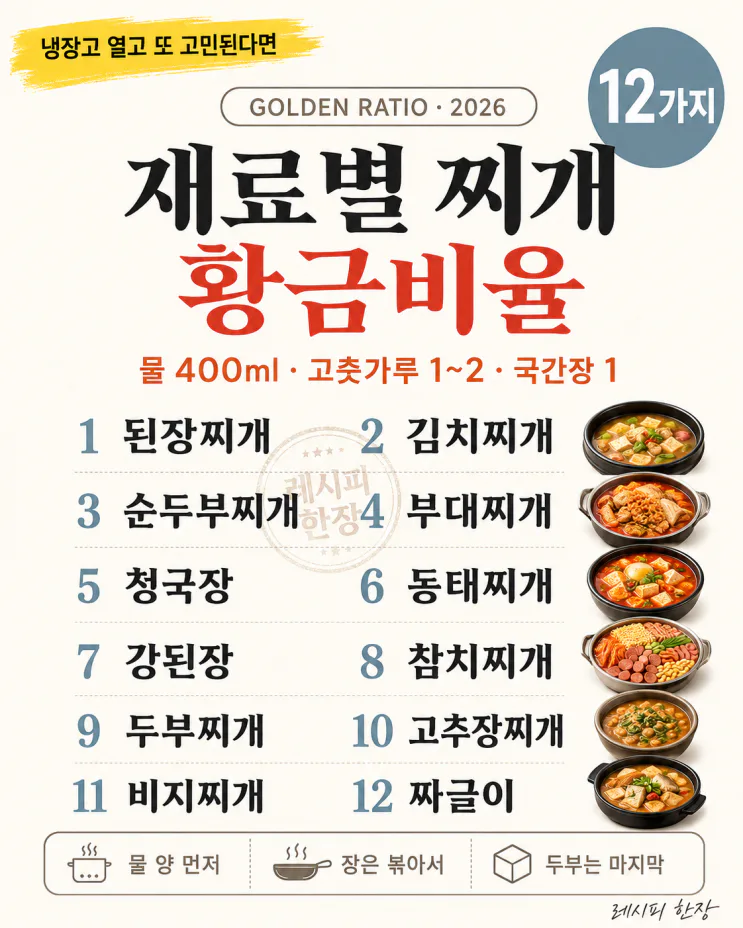
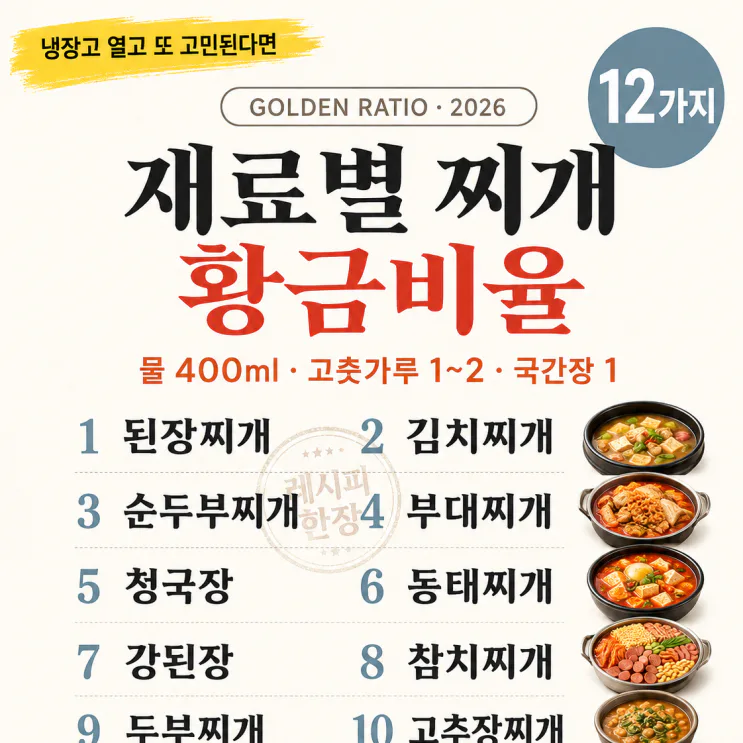
Don't cook stew every night — 12 golden ratios for stew ingredients
400ml of water with 1~2 tablespoons of gochugaru (Korean red pepper flakes) and 1 tablespoon of Korean soup soy sauce are the bones of the clear broth. The types of paste such as doenjang and chongkukjang use water...
Add 1~2 tablespoons of gochugaru (Korean red pepper flakes) to 400ml of water,
Korean soup soy sauce 1 tablespoon is the backbone of the spicy broth.
Types of sauces like doenjang and chungkukjang are
Just reduce the water and increase the intestines.
If you just memorize the ratio, even if the ingredients change
The small one doesn't shake.
First determine the amount of water,
Is it Jang gochugaru (Korean red pepper flakes)?
Select, and finish with soy sauce at the end.
If you first tell me the standard amount
400ml of water or broth for 2 people,
A half of the tofu and a handful of vegetables are enough.
The ratio below is the value adjusted to this 400ml.
If you increase the amount, you can multiply it at the same ratio.
12 soups by ingredients at a glance
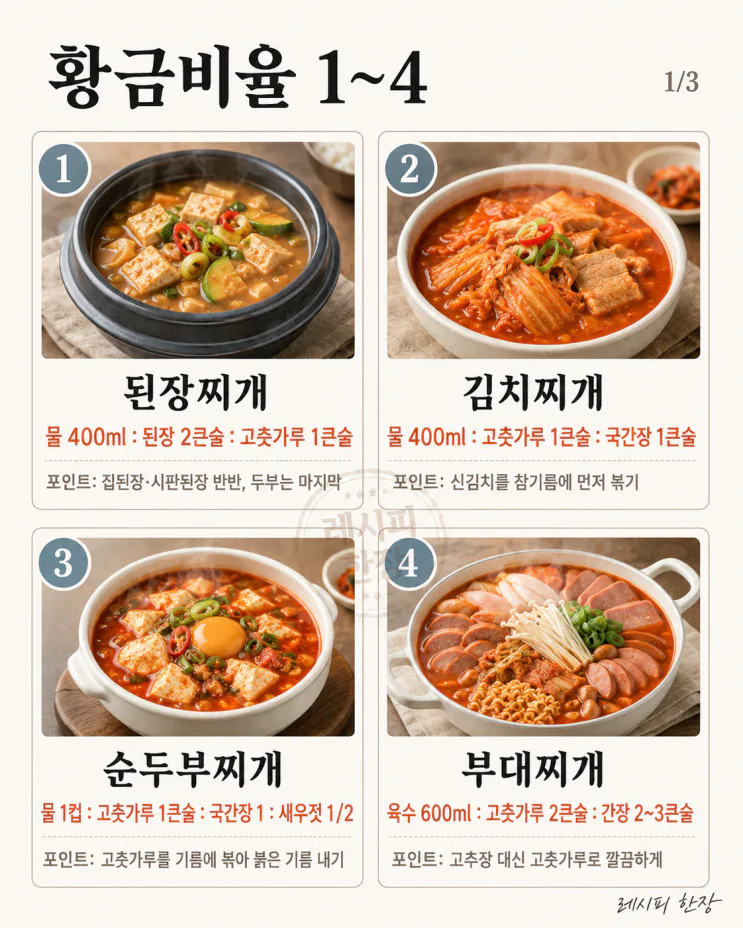
1. doenjang jjigae (Korean soybean paste stew)
2 tablespoons of doenjang in 400ml of water,
gochugaru (Korean red pepper flakes) 1 tablespoon is the basic ratio.
If you mix homemade miso paste and store-bought miso paste in equal parts
It has a rustic taste without being spicy.
Add 1 tablespoon of garlic and tofu at the end.
2. kimchi jjigae (Korean kimchi stew)
400ml of water with 1 tablespoon of gochugaru (Korean red pepper flakes),
Korean soup soy sauce If it's 1 big spoon, it's the right amount.
Sauté the new kimchi first in sesame oil
You have to add the kimchi broth together to make it deep.
If the kimchi is not quite sour, add a little sugar.
3. Sundubu stew
When you boil the tofu, only one cup of water is needed.
gochugaru (Korean red pepper flakes) 1 tablespoon, Korean soup soy sauce 1 tablespoon,
A half cup of shrimp sauce is the key to the savory flavor.
Fry gochugaru (Korean red pepper flakes) in oil until it turns into red oil.
If you put silken tofu after serving, it tastes like a restaurant.
4. Side stew
600ml of broth with 2 tablespoons of gochugaru (Korean red pepper flakes),
The marinade consists of 2~3 tablespoons of soy sauce and 1 tablespoon of garlic.
If you put gochujang (Korean red chili paste), it gets thick.
It's clean to catch mainly gochugaru (Korean red pepper flakes).
The ham has a salty taste, so season it later.
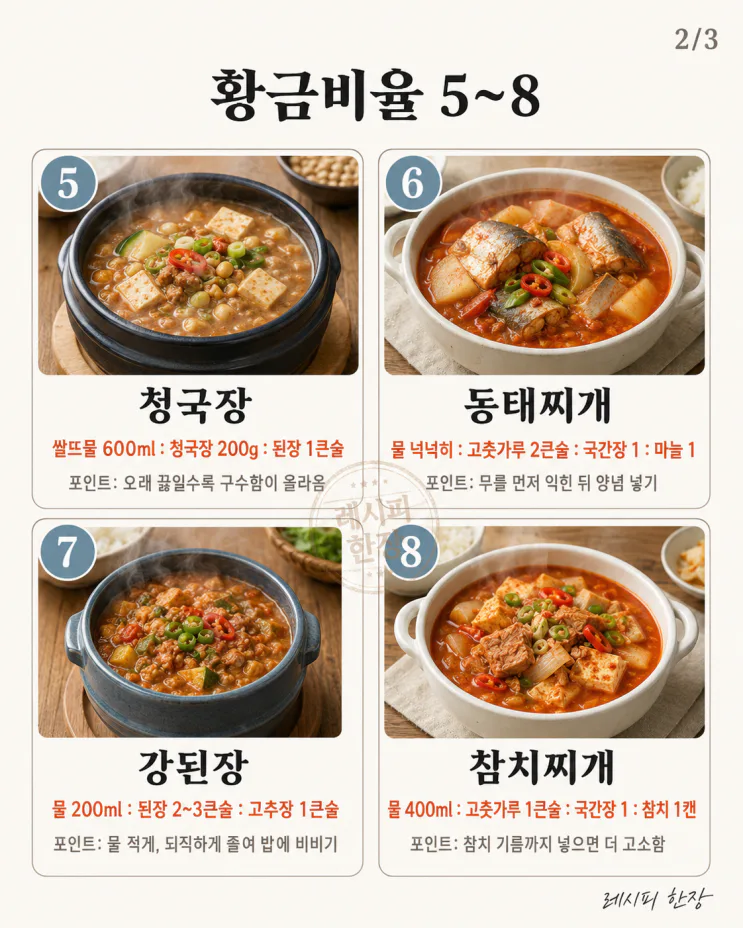
5. bean-paste soup prepared with ground fermented soybeans
600ml of rice water with 200g of chongkukjang,
It becomes more savory if you add 1 tablespoon of doenjang.
6. Dongtae stew
Pour enough water to cover the ingredients, and
gochugaru (Korean red pepper flakes) 2 tablespoons·Korean soup soy sauce 1 tablespoon·Garlic 1 tablespoon.
7. Strong soy sauce
Only 200ml of water is homemade,
Thicken with 2~3 tablespoons of doenjang and 1 tablespoon of gochujang (Korean red chili paste).
8. Tuna stew
400ml of water with 1 tablespoon of gochugaru (Korean red pepper flakes),
Korean soup soy sauce One tablespoon, one can of tuna is enough.
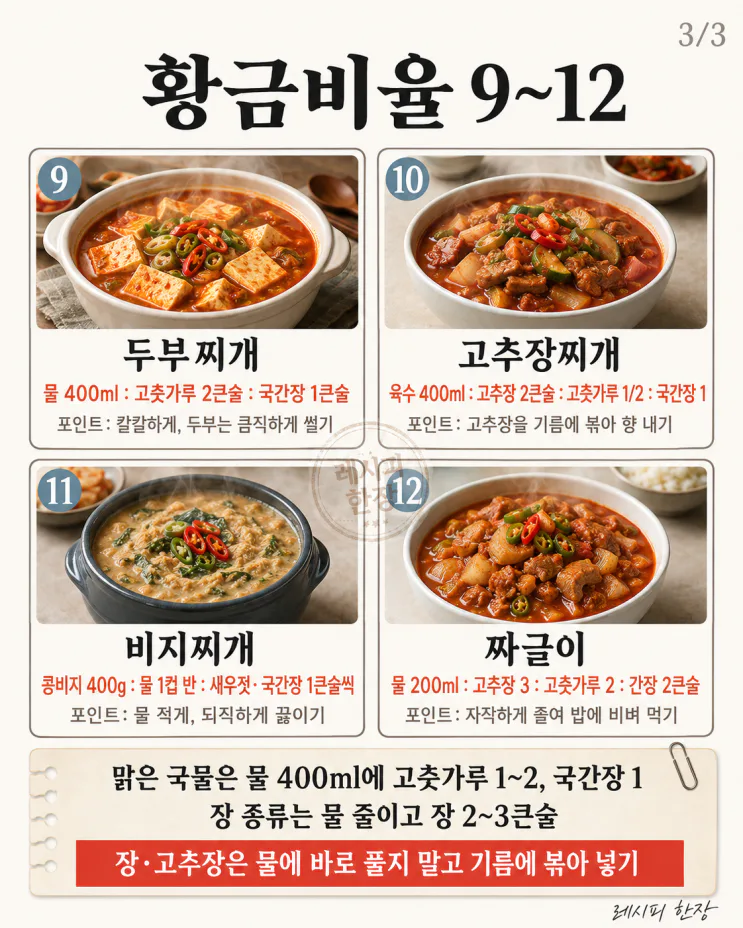
9. Tofu stew
400ml of water with 2 tablespoons of gochugaru (Korean red pepper flakes),
Korean soup soy sauce Boil it with a little salt with 1 tablespoon.
10. gochujang (Korean red chili paste) stew
400ml of broth with 2 tablespoons of gochujang (Korean red chili paste),
gochugaru (Korean red pepper flakes) half a glass, Korean soup soy sauce 1 full glass.
11. Bibimbap
Only half a cup of water for 400g of mung bean porridge,
Add 1 tablespoon of shrimp paste [HANKKI_TERM_0000] and stir well.
12. Jagal
Only 200ml of water is homemade,
gochujang (Korean red chili paste) 3·gochugaru (Korean red pepper flakes) 2·Boil with 2 tablespoons of soy sauce.
The clear and spicy broth is made with 400ml of water.
gochugaru (Korean red pepper flakes) 1~2, Korean soup soy sauce 1.
The type of soup is with 200~600ml of water
Take 2~3 tablespoons of rice, the less water you use, the more chewy it becomes.
Caution
If you immediately dissolve Jang or gochujang (Korean red chili paste) in water
It's dull and goes around in circles.
First stir-fry in oil to infuse the flavor
You need to add water to make the broth thicker.
Don't try to match everything from the beginning.
Kimchi, ham, and pickles already have a salty taste.
It's safer to check and add it at the end after boiling.
One thing to remember as a representative
After the tofu is boiling vigorously in the broth
Put it in in the last 2~3 minutes.
If you put it in early and boil it for a long time
The hole is suddenly punched and becomes hard.
You have to put it at the end to make it soft and absorb well.
The soup gets deeper when it boils for a long time.
No, it's the order of ingredients that determines the taste.
Frequently asked questions
Q. Can I use pure water without boiling water?
A. That's fine. Instead, how many sardines?
Just adding one piece of seaweed will make it deeper.
Q. Which one is better, gochugaru (Korean red pepper flakes) or gochujang (Korean red chili paste)?
A. Clear and spicy is gochugaru (Korean red pepper flakes),
The deep and heavy taste is on the gochujang (Korean red chili paste) side.
Q. What should I do when I get angry?
A. Add a little more water and put tofu or radish
If you put it in and boil, the seasoning will become soft.
Saltiness of brine varies from household to household.
Set the ratio as the default
Adjust it to your taste.
Clear broth is made with 400ml of water.
gochugaru (Korean red pepper flakes) 1~2, Korean soup soy sauce 1.
Reduce the amount of rice and add 2~3 tablespoons of rice.
With these two lines, there are 12 things.
What stew do you want for dinner?
Do you boil it the most often?
#StewRecipe #doenjang jjigae (Korean soybean paste stew) #kimchi jjigae (Korean kimchi stew) #Soft Tofu Stew #StewGoldenRatio #Home-cookedRecipe #DinnerMenu #SoupDish #MarinadeRatio #DIYCooking #StewMakingMethod #Baek JongwonRecipe #OneRecipePage #OneMealWorkshop