


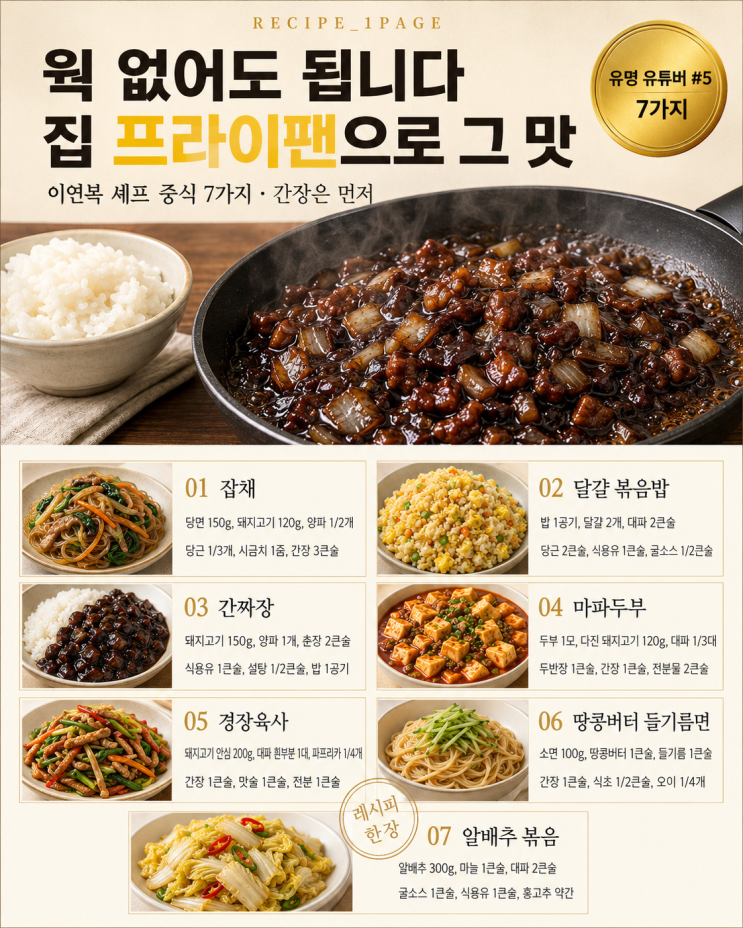
7 Chinese dishes by Lee Yeonbok chef that can be made without wok - You don't have to go to a Chinese restaurant
When I had lunch at home, I always felt something was missing. Even if I used the same ingredients, it didn't taste like the one I used at the restaurant. I thought it was because of the wok. I thought it was because the flame was too weak. But when I saw what Chef Lee Yeon-bok had told me on the broadcast and YouTube, I realized it wasn't a wok problem.
If you have lunch at home
I was always lacking something.
Even if you put the same ingredients
I don't smell that scent I used to eat at the restaurant.
I thought that was because of work.
It's because the fire is weak.
But Chef Lee Yeonbok
I saw what they told me on the broadcast and YouTube
It wasn't a work problem.
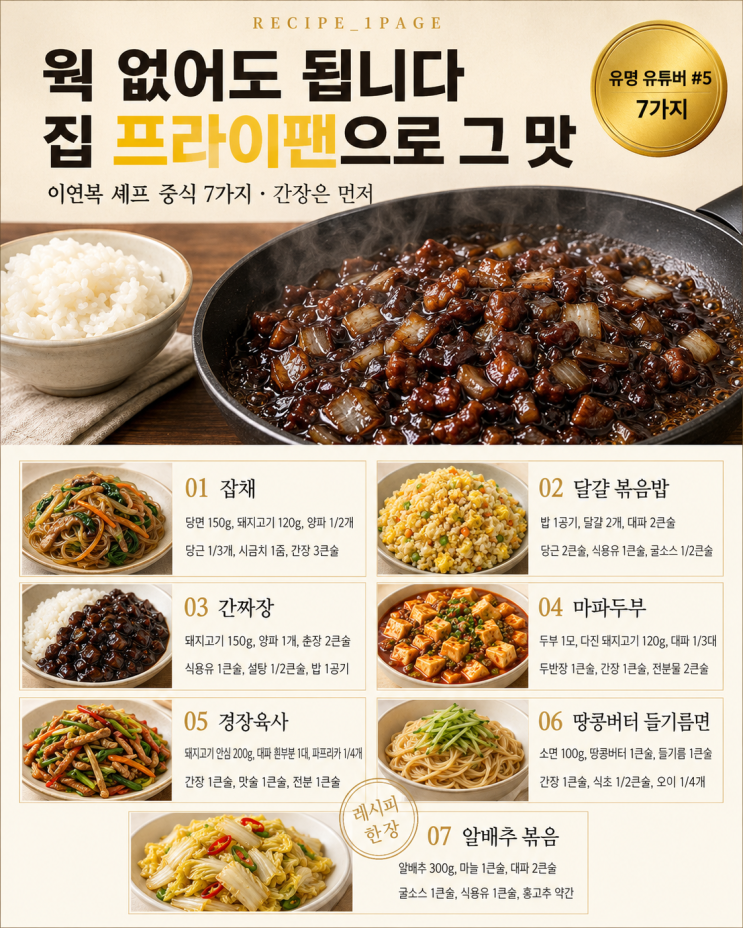
**When do you put soy sauce in?**
This was big.
Add soy sauce first when frying the meat.
Smelling like support from the fan floor
This is the characteristic smell of Chinese cuisine.
If you put it in later to match the seasoning
It just tastes salty.
The seven below are
The way introduced on broadcasts and YouTube
It's organized based on the household frying pan.
The exact measurement has not been confirmed
I wrote it in order instead of a ratio.
—
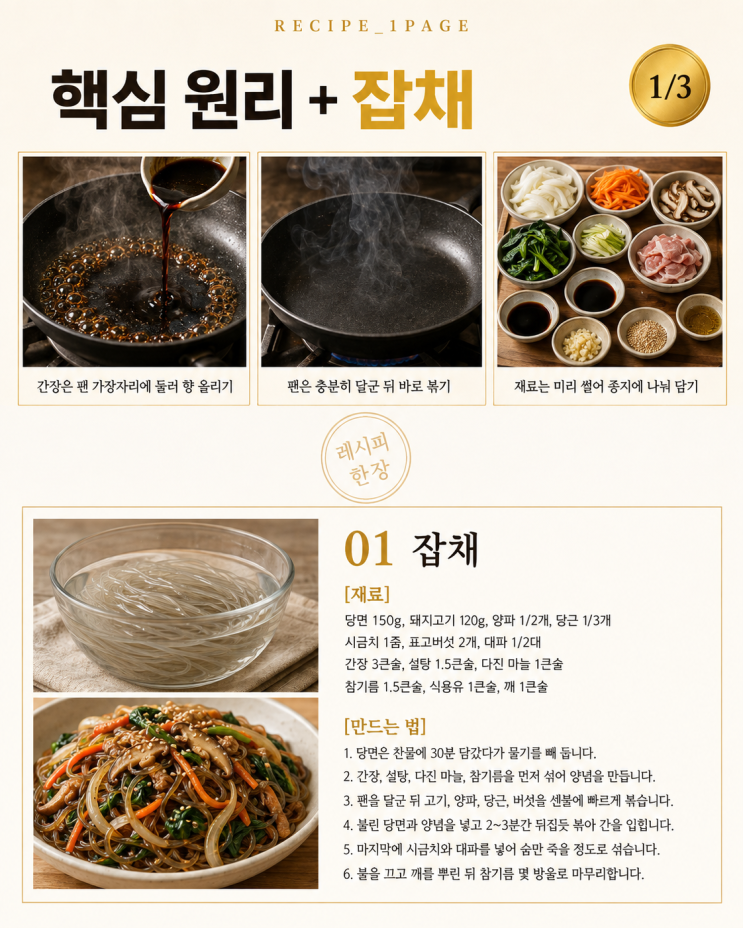
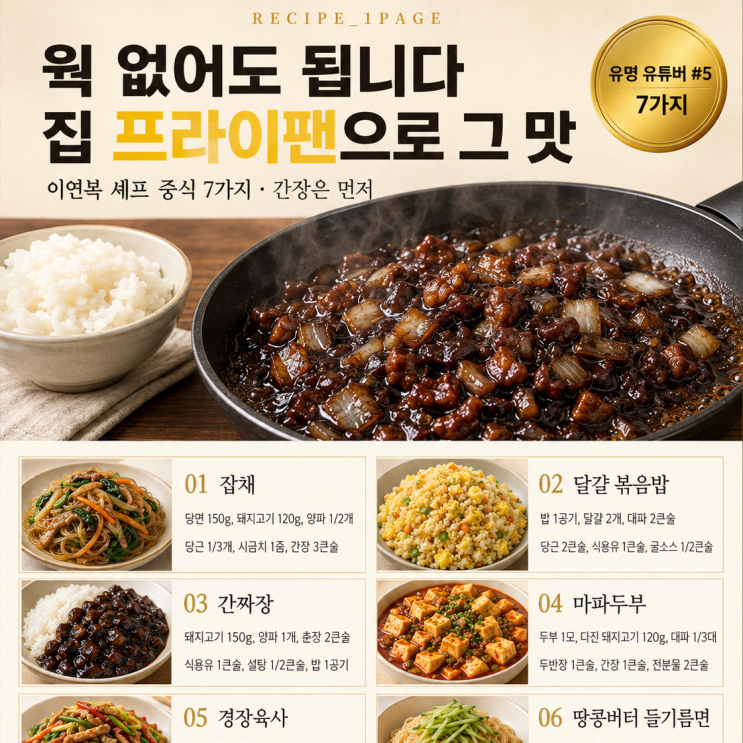
1. Uncooked rice noodles (30 minutes + soaking
[Ingredients]
Glass noodles 200g, beef 150g, a handful of spinach,
3 shiitake mushrooms, ½ onion, ⅓ carrot
[Meat seasoning]
1 tablespoon soy sauce, ½ tablespoon sugar, minced garlic ½ tablespoon
[Whole seasoning]
4 tablespoons soy sauce, 2 tablespoons sugar, sesame oil 2 tablespoons, pepper
How to make it
Soak the rice noodles in cold water for 2~3 hours. (Do not cook)
Blanch spinach in boiling salted water for 30 seconds.
Rinse with cold water and squeeze well.
Fry the vegetables separately and place them on a plate.
While frying the meat in the pan 1 tablespoon of soy sauce
Put it in first to infuse the scent
Add the soaked glass noodles and pour in the remaining seasoning and stir-fry.
When the glass noodles become soft, mix all the vegetables together.
Finish with sesame oil and Tongkye
Cooked lotus root has already been soaked in water.
The vinegar is floating around.
The soaked dangmyeon absorbs the seasoning while being stir-fried.
It's chewy and goes all the way to the inside.
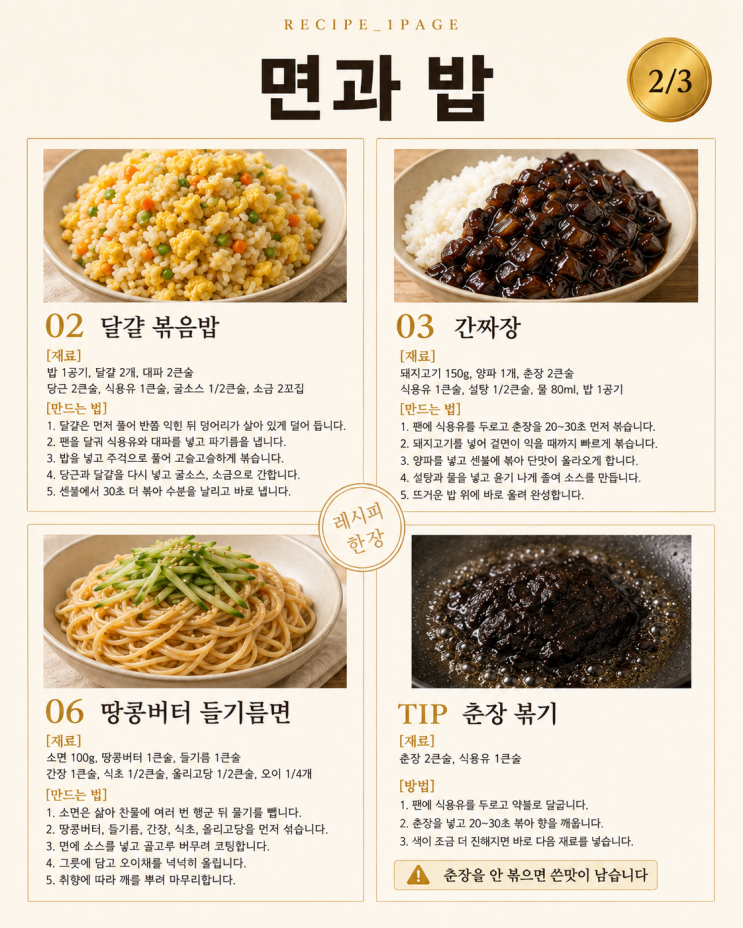
2. Egg fried rice
[Ingredients]
2 cups of cold rice, 3 eggs, 1 bunch of scallions, 3 tablespoons of cooking oil
[Seasoning] 1/3 teaspoon salt, 1 tablespoon oyster sauce, pepper
In the version made at home for the broadcast
This is the menu that was introduced.
How to make it
Crack the eggs and season with salt.
Heat the fan enough and apply plenty of oil.
Pour the eggs and take them out of the plate when they are half cooked.
In the same pan, stir-fry the scallions and add oil.
Add cold rice and stir and stir-fry.
Pour the oyster sauce around the edge of the pan.
Add the eggs that you have set aside and mix only two or three times.
If you stir-fry eggs and rice together from the beginning
The egg sticks completely to the rice grains.
Please make it with cold rice.
Freshly cooked rice is moist and becomes sticky.
—
3. Ganjangjang
[Ingredients]
200g pork, 2 onions, ½ zucchini, 1/4 head cabbage
[Seasoning]
4 tablespoons of chunjang, 5 tablespoons of edible oil, 1 tablespoon of sugar, 200ml of water
[Concentration]
1 tablespoon starch + 2 tablespoons water
How to make it
Put 5 tablespoons of cooking oil on the fan Fry the chunjang on low heat for 2~3 minutes.
Separate the stir-fried chunjang and keep it aside.
While frying the meat in the same pan, add ½ tablespoon of soy sauce to season it.
Sauté the onions for a long time until they are translucent and sweet.
Add the remaining vegetables and stir-fry.
Add 200ml of fried chunjang, sugar, and water and boil for 5 minutes.
Add the starch powder little by little to adjust the concentration.
The ramen at home is bland.
It's because I didn't stir-fry the chunjang.
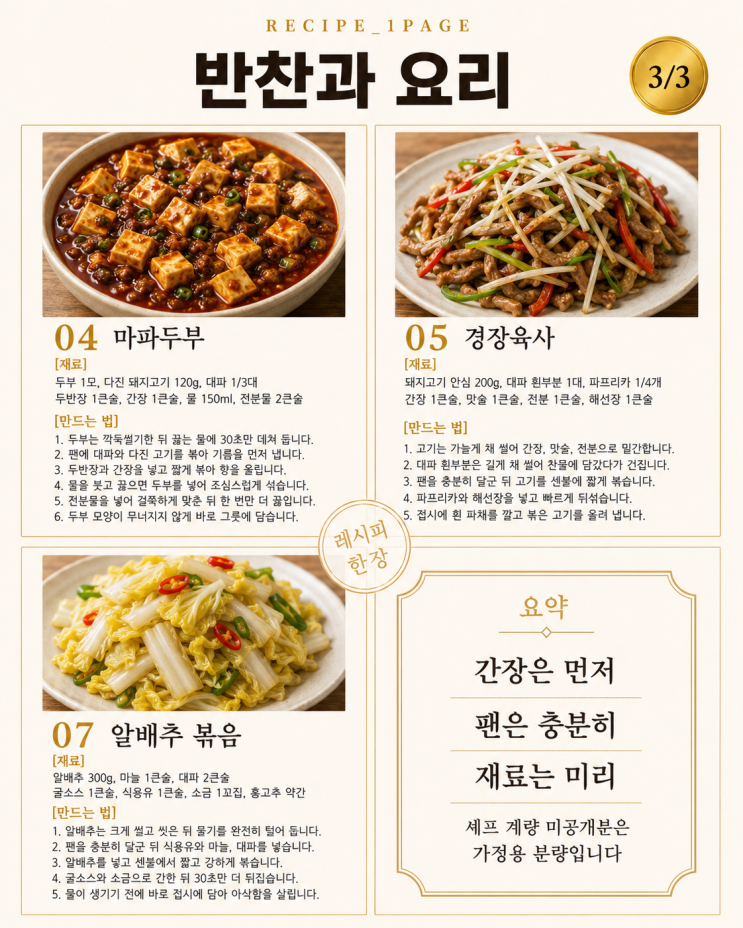
4. Mapo tofu
[Ingredients]
1 block of tofu, 150g minced pork, 1 bunch of scallions,
minced garlic 1 tablespoon
[Seasoning] doubanjiang 1 tablespoon, gochugaru (Korean red pepper flakes) 1 tablespoon,
Soy sauce 1 tablespoon, sugar ½ tablespoon, water 200ml
[Concentration] Starch 1 tablespoon + Water 2 tablespoons
This is a menu that has been introduced several times on the broadcast.
How to make it
Boil the tofu in boiling salted water for 1 minute. Save it
Heat oil in a pan and stir-fry the ground meat.
First add 1 tablespoon of soy sauce to infuse the flavor.
Sauté garlic and doubanjiang, gochugaru (Korean red pepper flakes).
Pour 200ml of water and boil.
Put tofu in Don't stir it, shake the fan instead.
Adjust the concentration with starch and add the scallions.
If you cook it with a spoon, the tofu will all clump together.
If you crush it and put it in, it will break much less.
5. Gyeongjang Meat Academy
[Ingredients]
Pork tenderloin 200g, 2 scallions, 1 tablespoon of starch
[Meat seasoning]
1 tablespoon of Cheongju beer, salt and pepper, 1 tablespoon of starch
[Seasoning] Chunjang 2 tablespoons, edible oil 3 tablespoons, sugar 1 tablespoon,
½ tablespoon soy sauce, 3 tablespoons water
How to make it
Slice the meat thinly
Season with Cheongju, salt, and pepper Mix with 1 tablespoon of starch
Slice the scallions thinly and soak them in cold water to remove the spiciness.
Heat oil in the pan and stir-fry chunjang for 2 minutes.
Make the sauce by adding sugar, soy sauce, and water.
Fry the meat quickly on high heat.
Toss it with the sauce and put it on the scallions.
If you mix it with rice flour
Even when stir-fried, the meat is soft.
6. Peanut butter sesame oil noodles
[Ingredients] 1 serving of rice vermicelli or glass noodles, ⅓ cucumber
[Sauce] 1 tablespoon peanut butter, 1 tablespoon sesame oil, 1 tablespoon soy sauce, ½ tablespoon sugar, ½ tablespoon vinegar, 2 tablespoons rice water
How to make it
Boil the noodles and rinse them several times in cold water.
Mix all the sauce ingredients in a bowl.
Add 2 tablespoons of rice water to dilute the concentration.
Put the noodles in and stir
I will upload cucumber slices.
It's a noodle that is seasoned with sauce
If you want to put plenty of vegetables
Please also increase the sauce.
7. Stir-fried cabbage
It's a stir-fried side dish that takes only 5 minutes.
[Ingredients] ½ head of cabbage, minced garlic 1 tablespoon, a little scallion
[Seasoning] Oyster sauce 1 tablespoon, soy sauce ½ tablespoon, edible oil 2 tablespoons
How to make it
Slice the cabbage into bite-sized pieces.
Heat the fan enough and coat it with oil.
Sauté garlic to release its aroma.
Sauté the cabbage on high heat for 3 minutes quickly.
Put the oyster sauce and soy sauce around the edges of the pan.
Cook for 30 seconds longer and turn off the heat.
If you cook it for a long time, water will come out.
It is stuck on the bottom of the plate.
Three things when having Chinese food at home
Liver first –
Place it on the fan base to release the fragrance.
If you add it later, it only tastes salty.
To fully excite the fans -
Even without work, if you properly warm up the fans
It has a similar smell.
If you put ingredients into lukewarm fans
It's not stir-fried, it's boiled.
Pre-slice all the ingredients in advance -
Chinese food is cooked in a short time
I don't have a chance to grab the knife in the middle.
Not because there is no work
It was because I didn't know the order.
Soy sauce first, enough fans,
The materials are in advance
With these three, even in the house's frying pan
It looks pretty similar.
The one I want to try the most among these
What is it?
#LeeYeonbokRecipe #ChineseFood #Home-cookedMealMenu #SimpleDinnerMenu #Ganjajang #MapoDoufu #FriedRice #Jajae #DinnerMenuRecommendation #ChefRecipe #Home-cookedFoodInstagram #ChineseFood